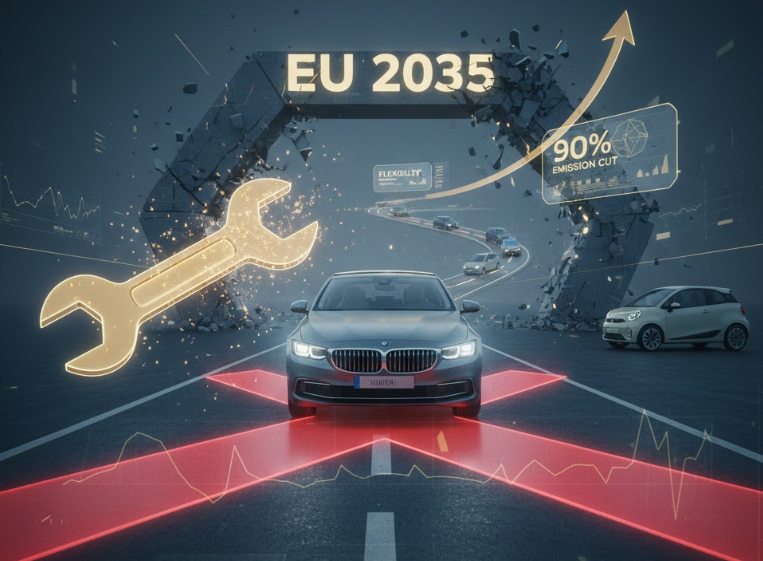
Seven European Union member states are asking the European Commission to revisit its plan to ban the sale of new petrol and diesel cars starting in 2035. Their request comes ahead of the Commission’s upcoming review of vehicle emission rules, expected to be released this week.
In two separate letters seen by Euronews, the countries raise concerns about the pace of the transition to electric vehicles and the pressure it places on domestic carmakers.
Push for Hybrid and Alternative Technologies
Bulgaria, the Czech Republic, Germany, Hungary, Italy, Poland, and Slovakia have joined efforts to push for a more flexible approach. They are not asking to drop emission goals, but they want the Commission to allow other technologies beyond battery electric vehicles.
The group argues that hybrid models, as well as vehicles powered by hydrogen or biofuels, should still be permitted after 2035. They believe this would help keep the European car industry stable while meeting environmental targets.
In one letter signed by six countries—excluding Germany—they said that rules should give governments room to choose the best path forward. They also called for better charging networks and more hydrogen refuelling points across the region.
German and Italian Concerns on Industry Stability
Germany and Italy, home to many of Europe’s largest automakers, submitted a joint letter stating their concerns.
“We aim to maintain the strategic independence of the European automotive industry,” the letter said.
Both countries say their manufacturers are facing high energy prices, rising costs, and delays in battery supplies. They also point to weak demand for electric cars in several markets.
German lawmakers are backing efforts to change the current law. Member of the European Parliament Jens Gieseke said the legislation should make room for “CO2-neutral fuels,” so that clean internal combustion engines could stay on the market beyond 2035.
Competition From China Pressures EU Carmakers
European automakers are under increasing pressure from fast-growing Chinese electric vehicle companies. Brands like BYD are expanding across the continent, offering cheaper models and gaining market share.
Even Tesla, once the leader in Europe’s electric car market, has seen falling sales. Official figures show a sharp drop in registrations in countries such as France, Sweden, Denmark, and Portugal.
Sigrid de Vries, head of the European Automobile Manufacturers’ Association, said the current EU policy only focuses on pushing carmakers to produce electric models. She said the rules do little to boost consumer interest or improve infrastructure.
“The 2035 target is no longer realistic,” she stated.
Commission Review Expected This Week
The European Commission is set to publish its review of vehicle emissions rules for cars and vans in the coming days. However, there are signs that the final proposal may be delayed.
In earlier statements, Commission officials suggested the review might take more time due to growing pressure from member states and the industry. The Commission has not yet confirmed if any part of the 2035 deadline will change.
The seven countries lobbying for changes represent around half of the EU’s population. They have consistently warned that a complete ban on internal combustion engines could hurt jobs, slow production, and reduce Europe’s ability to compete in global car markets.