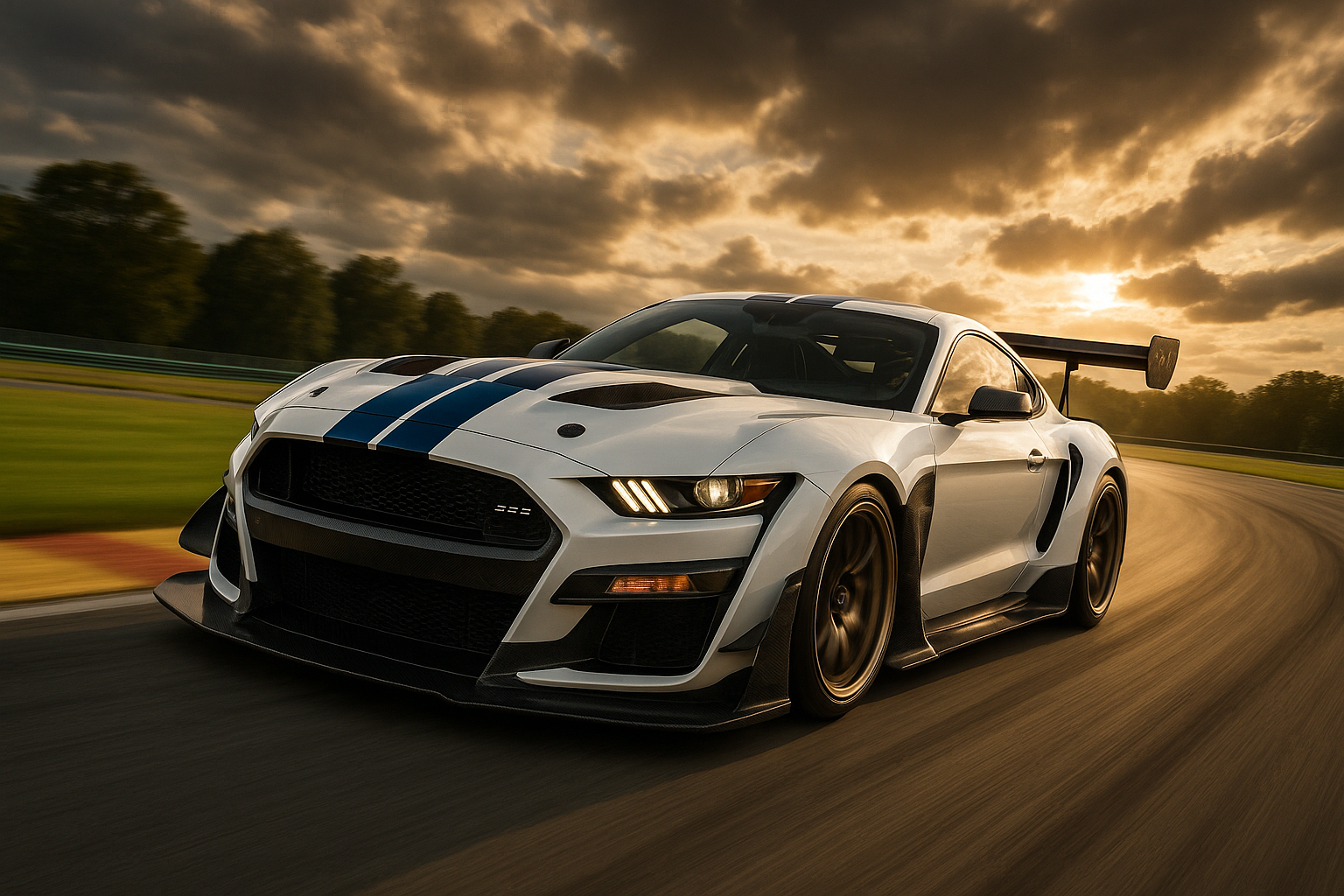
The Ford Mustang GTD has just obliterated expectations at Germany’s legendary Nürburgring Nordschleife, posting a blistering 6:57.685 lap time that officially crowns it as the fastest American production car to ever tackle the Green Hell.
This achievement isn’t just a number on a stopwatch—it’s a seismic shift in how the world views American automotive engineering. The Mustang GTD has joined an exclusive club of sub-seven-minute production cars, sitting alongside European exotics that cost twice as much.
Breaking Down the Record-Setting Performance
Professional racing driver Multimatic’s test pilot achieved the record-breaking time in near-perfect conditions, with the track surface providing optimal grip levels. The 6:57.685 time places the Mustang GTD ahead of several prestigious supercars, including the McLaren 720S and Lamborghini Huracán Performante.
What makes this achievement even more remarkable is the car’s price point. At approximately $325,000, the Mustang GTD delivers Nürburgring performance that previously required seven-figure investments.
Engineering Marvel Behind the Speed
The GTD’s record-breaking performance stems from its sophisticated engineering package:
- Supercharged 5.2-liter V8 producing over 815 horsepower
- Carbon fiber body panels reducing weight by 200+ pounds
- Active aerodynamics generating 1,100 pounds of downforce
- Michelin Pilot Sport Cup 2 R tires developed specifically for this application
- Multimatic adaptive spool valve dampers with track-tuned suspension geometry
Ford’s collaboration with Multimatic, the Canadian engineering firm behind Ford’s Le Mans-winning GT program, proved crucial in achieving this milestone.
What This Means for American Performance Cars
This Nürburgring lap record represents more than just bragging rights. It signals a fundamental shift in American automotive capabilities, proving that Detroit can build cars that compete with the best from Stuttgart, Maranello, and Sant’Agata Bolognese.
The achievement comes at a critical time for Ford’s performance division, as the company navigates the transition toward electrification while maintaining its performance car heritage. The Mustang GTD serves as a technological showcase and a statement of intent.
Track-Focused DNA Meets Street Legality
Unlike many track-focused supercars that sacrifice daily usability, the Mustang GTD maintains full street legality across global markets. This includes meeting stringent European emissions and safety regulations while delivering this level of performance.
The car features multiple drive modes, including a dedicated Track mode that optimizes all systems for maximum performance. The active suspension system can lower the car by 40mm in Track mode, while the active rear wing adjusts automatically based on speed and driving conditions.
Production and Availability Details
Ford plans to build just 1,000 units of the Mustang GTD globally, with production already underway at the company’s Flat Rock Assembly Plant in Michigan. Each car undergoes extensive quality control processes, including individual chassis setup and alignment procedures typically reserved for race cars.
The limited production run has created intense demand, with Ford reporting that initial allocation sold out within hours of the order books opening. Secondary market values are already trending above MSRP, indicating strong collector interest.
Global Market Impact
This achievement positions Ford to compete more aggressively in international performance car markets, particularly in Europe where American cars have traditionally struggled to gain credibility among enthusiasts.
The Nürburgring time provides quantifiable proof of the GTD’s capabilities, potentially opening doors to markets where lap times carry significant weight in purchasing decisions.
The Mustang GTD’s record-breaking Nürburgring lap time marks a watershed moment for American performance cars. As Ford continues developing next-generation performance vehicles, this achievement sets a new benchmark and proves that American engineering can compete at the highest levels of automotive performance.