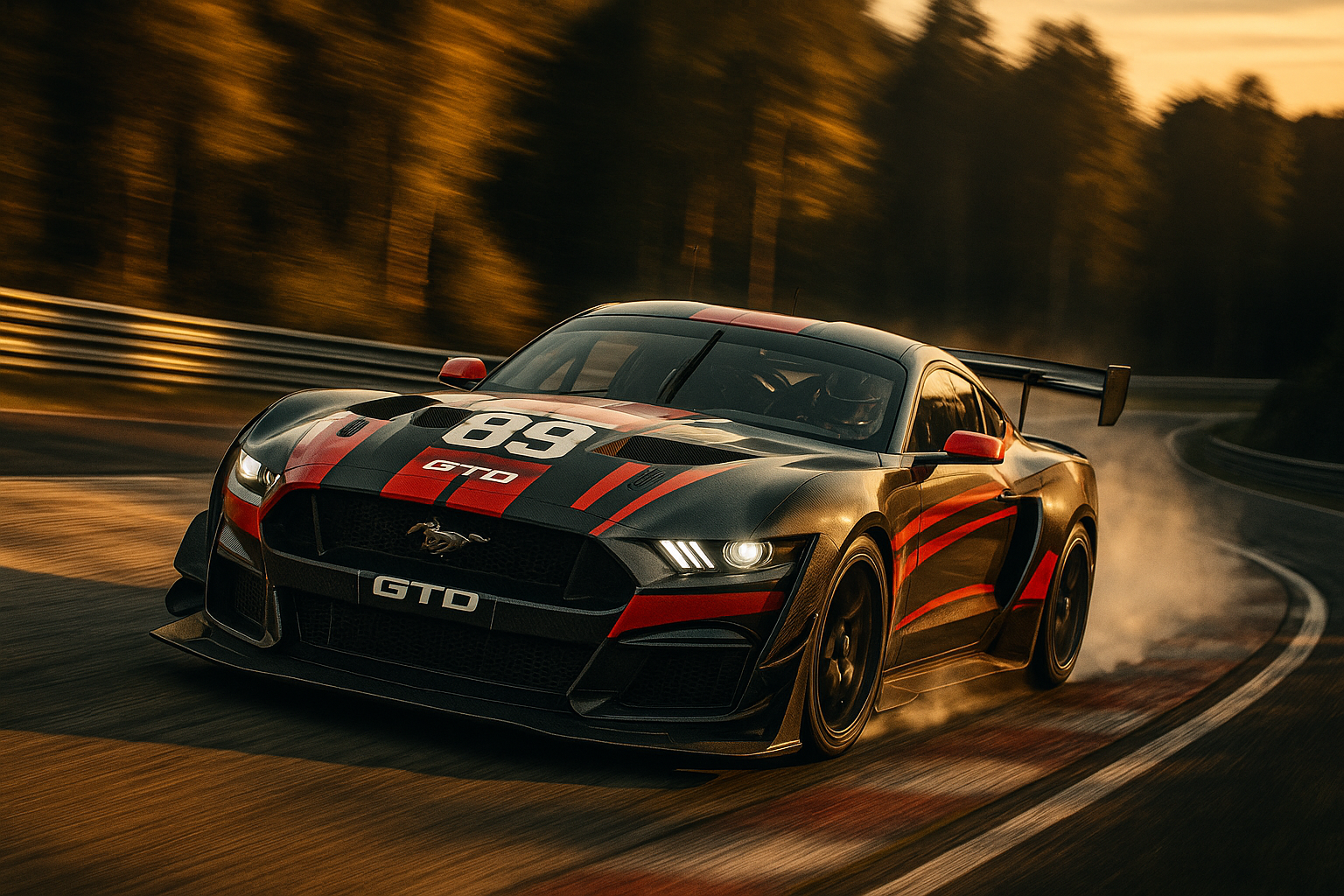
Ford just dropped a bombshell on the supercar establishment. The American automaker’s Mustang GTD has officially lapped the Nürburgring Nordschleife in 6 minutes and 57.685 seconds, making it the fastest production car to ever conquer the Green Hell’s 12.9-mile gauntlet.
This isn’t just a win for Ford—it’s a seismic shift in the performance car hierarchy. The Mustang GTD, priced at $325,000, has beaten some of Europe’s most prestigious million-dollar hypercars on their home turf, including the Mercedes-AMG One’s previous 6:29.090 time in the overall production car category.
Ford Mustang GTD Nürburgring Achievement Breakdown
The lap was completed on October 17, 2024, with professional racing driver Dirk Müller behind the wheel. Müller, a factory Ford driver with extensive Nürburgring experience, piloted a production-spec Mustang GTD fitted with optional carbon fiber wheels and Michelin Pilot Sport Cup 2 R tires.
What makes this achievement particularly significant is that Ford specifically targeted the Nürburgring during the GTD’s development. The car underwent extensive testing at the circuit, with engineers making countless aerodynamic and suspension refinements based on real-world data from the track.
Technical Specifications Behind the Record
The Mustang GTD isn’t your garden-variety pony car. Under the hood sits a supercharged 5.2-liter V8 producing over 800 horsepower, mated to an eight-speed dual-clutch transmission. But raw power alone doesn’t conquer the Nordschleife.
Key performance features include:
- Semi-active suspension with adaptive dampers that read the road 500 times per second
- Active aerodynamics generating up to 1,100 pounds of downforce at top speed
- Carbon ceramic brakes with massive 16.5-inch front rotors
- Lightweight carbon fiber body panels and wheels reducing overall mass
- Rear-mounted transaxle for optimal weight distribution
Ford’s Multimatic-developed suspension system deserves special mention. The same company that engineers dampers for Formula One teams helped create a setup that keeps the GTD planted through the Nordschleife’s notorious elevation changes and compression zones.
What This Means for American Performance Cars
For decades, European manufacturers have dominated Nürburgring lap times, treating the circuit as their personal proving ground. American muscle cars, while powerful in straight lines, were often dismissed as lacking the sophistication for proper road course work.
The Mustang GTD demolishes that stereotype entirely. This is a purpose-built track weapon that happens to be street legal, representing Ford’s most ambitious performance project since the GT supercar program.
The achievement also validates Ford’s decision to create a halo Mustang variant. While $325,000 might seem steep for a Mustang, the GTD now stands among genuine supercar company, having proven itself against vehicles costing two or three times as much.
Limited Production and Exclusivity
Ford Performance isn’t building these in volume. The Mustang GTD remains strictly limited production, with customers undergoing an application process similar to Ferrari’s allocation system. Each car is hand-assembled at Ford’s Performance facility in Flat Rock, Michigan.
Production began in late 2024, with deliveries already underway to approved buyers. Ford has not disclosed exact production numbers, but industry insiders suggest fewer than 1,000 units will be built annually.
The Competition Responds
Mercedes-AMG, Porsche, and Lamborghini now face a credible American challenger in the production car lap time wars. The Mustang GTD’s 6:57.685 puts it ahead of cars like the Lamborghini Aventador SVJ and Porsche 911 GT2 RS, both of which held previous records.
Expect European manufacturers to respond. Porsche is rumored to be developing a more aggressive GT2 RS variant, while Mercedes could unleash a more track-focused AMG One variant. The Nürburgring arms race just got significantly more interesting.
Looking Ahead
Ford’s Nürburgring triumph with the Mustang GTD proves American manufacturers can build world-class track cars that compete with—and beat—the European establishment. This record will likely stand until another manufacturer takes up the challenge, but for now, the fastest production car around the Nordschleife wears a blue oval and a galloping horse badge.
For Ford, this is more than bragging rights. It’s validation of a performance philosophy that combines American muscle with European finesse, and proof that when Detroit aims high, it can reach the absolute pinnacle of automotive achievement.