Key Facts
- Honda exploring return to European car production after exiting the region in recent years
- EU lawmakers voted to further relax CO2 emissions targets, providing relief to automakers
- New ‘Made in EU’ regulations creating incentives for local manufacturing over imports
- Regulatory shift may reshape manufacturing strategies across major global automakers
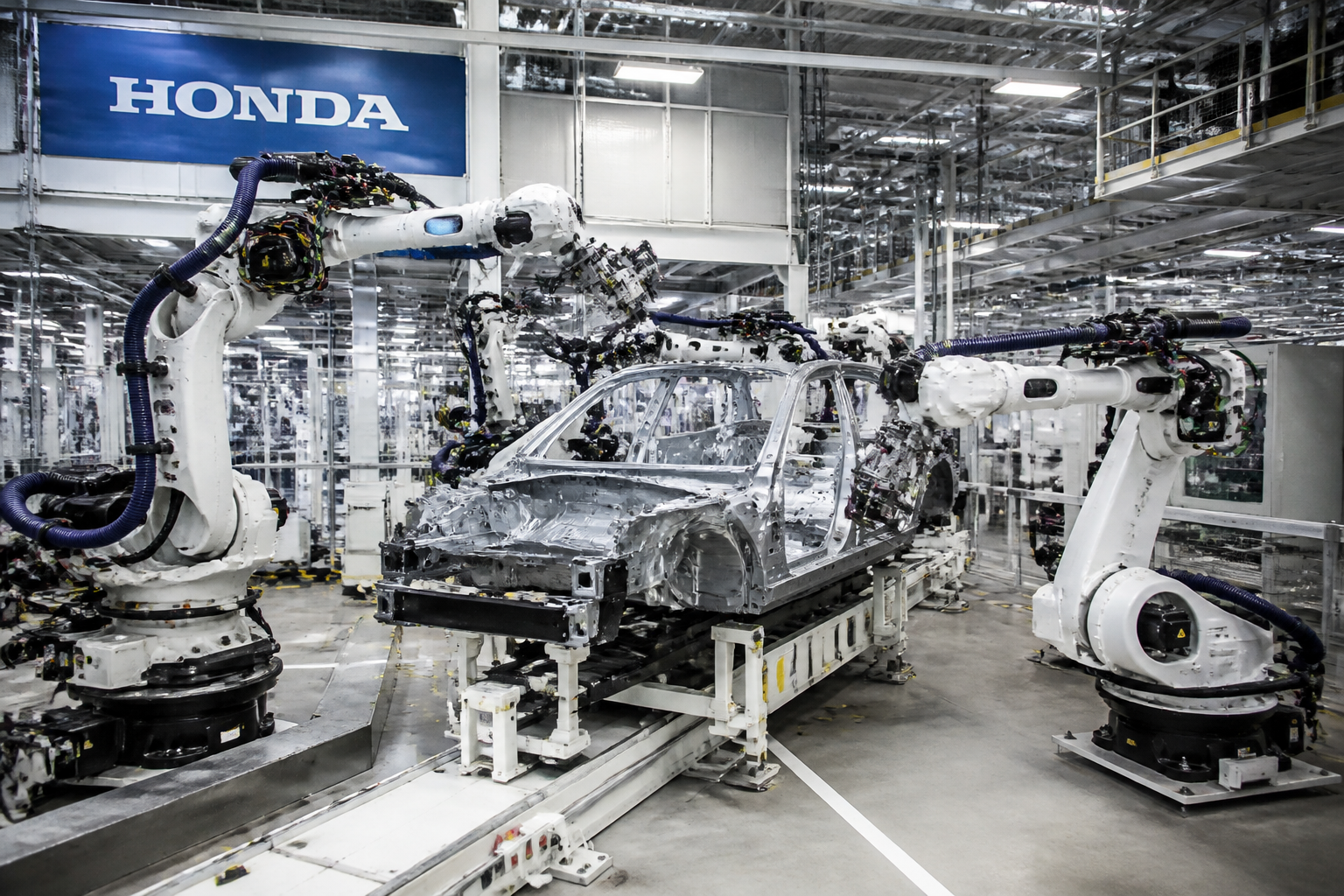
Honda is considering restarting car manufacturing in Europe following significant regulatory shifts that have eased CO2 emissions targets while introducing stricter local-content requirements. The dual policy changes create fresh economic incentives for automakers who abandoned European production in recent years.
The Japanese automaker is evaluating a potential return to European manufacturing as new ‘Made in EU’ regulations take shape, marking a dramatic reversal after the company closed its Swindon, UK plant in 2021. The move would represent one of the most concrete responses yet to Brussels’ evolving industrial policy framework.
Dual Regulatory Shifts Reshape European Auto Strategy
The European Union has implemented two parallel policy changes that are fundamentally altering the economics of automotive manufacturing in the bloc. EU lawmakers have voted to further ease CO2 emissions targets, offering manufacturers breathing room on electrification timelines that had threatened billions in potential fines.
Simultaneously, the introduction of ‘Made in EU’ content regulations creates preferential treatment for vehicles manufactured within the bloc’s borders. This carrot-and-stick approach appears designed to reverse the trend of automakers consolidating production in lower-cost regions while maintaining access to Europe’s lucrative consumer market.
For Honda specifically, the combination addresses the two primary factors that made European production economically unviable: punishing emissions compliance costs and competition from cheaper imports. The Swindon closure eliminated 3,500 direct jobs and thousands more in the supply chain, making any production restart politically as well as economically significant.
Implications for the European EV Transition
The relaxation of CO2 targets has sparked debate over Europe’s electric vehicle transition trajectory. Environmental advocates warn that easing pressure on automakers could delay the shift away from internal combustion engines, while industry groups argue the original timelines were economically destructive and technologically unrealistic given current battery supply chains and charging infrastructure gaps.
The ‘Made in EU’ regulations, however, could accelerate localized EV production by making it economically advantageous to build battery electric vehicles within Europe rather than importing them from manufacturing hubs in Asia. This creates a complex dynamic where the pace of electrification may slow slightly while the location of EV production shifts westward.
Honda’s potential return would likely focus on electrified vehicles rather than traditional internal combustion models, given the brand’s global pivot toward electrification. The company has committed to phasing out purely gasoline-powered vehicles by 2040 globally, making any European manufacturing restart a potential testbed for hybrid and battery electric platforms.
Employment and Supply Chain Considerations
A Honda production restart would carry significant employment implications across the UK and EU. The Swindon closure represented one of the largest manufacturing job losses in recent British industrial history, and any reversal would be politically popular in regions still recovering from automotive sector contraction.
Beyond direct manufacturing employment, automotive production supports extensive supplier networks spanning components, logistics, and specialized services. European suppliers have faced years of uncertainty as traditional automakers restructured and Chinese manufacturers captured growing market share through imports rather than local production.
The ‘Made in EU’ framework specifically aims to rebuild these supply networks by creating sustained demand for locally-sourced components and sub-assemblies. Whether this approach can compete with the scale advantages of Asian manufacturing hubs remains an open question that will likely determine the policy’s long-term success.
What This Means for Buyers
European car buyers may see several tangible effects from these regulatory shifts over the next three to five years. First, greater availability of mid-market models as manufacturers return to local production rather than prioritizing only premium vehicles that can absorb import costs and compliance expenses.
Second, potentially slower initial price increases on new vehicles as the relaxed emissions targets reduce manufacturer fines that would otherwise be passed to consumers. However, this could be offset by the inherently higher production costs of European manufacturing compared to Asian facilities.
Third, buyers committed to rapid electrification may face slightly longer waits for the broadest possible EV selection, as manufacturers adjust timelines to match the new regulatory reality. Conversely, those preferring hybrid technology or extended internal combustion availability gain additional years before facing purely electric-only new vehicle markets.
Honda’s specific model lineup for any European production restart remains undetermined, but the brand’s global focus on compact crossovers and electrified powertrains suggests vehicles like e:Ny1 electric SUV derivatives or advanced hybrid versions of CR-V-class models would be most likely candidates. Pricing would need to remain competitive with both established European brands and incoming Chinese manufacturers to justify the investment.
Broader Industry Response
Honda’s consideration of European production restart will be closely watched by other manufacturers evaluating similar moves. Several Asian brands reduced or eliminated European manufacturing over the past decade, viewing the region as primarily an export market rather than a production base.
If the new regulatory framework proves economically viable, it could trigger a broader reshoring trend among global automakers seeking to optimize their European operations. Conversely, if Honda ultimately decides against production restart after detailed analysis, it would signal that the incentives remain insufficient to overcome Europe’s structural cost disadvantages in automotive manufacturing.
The outcome will shape not just where Europeans can buy cars, but where those cars are built, how quickly the fleet electrifies, and whether the continent’s automotive employment base stabilizes or continues its long decline.